Twitter Updates

    follow me on Twitter
    Showing posts with label review. Show all posts
    Showing posts with label review. Show all posts

    Wednesday, 4 January 2012

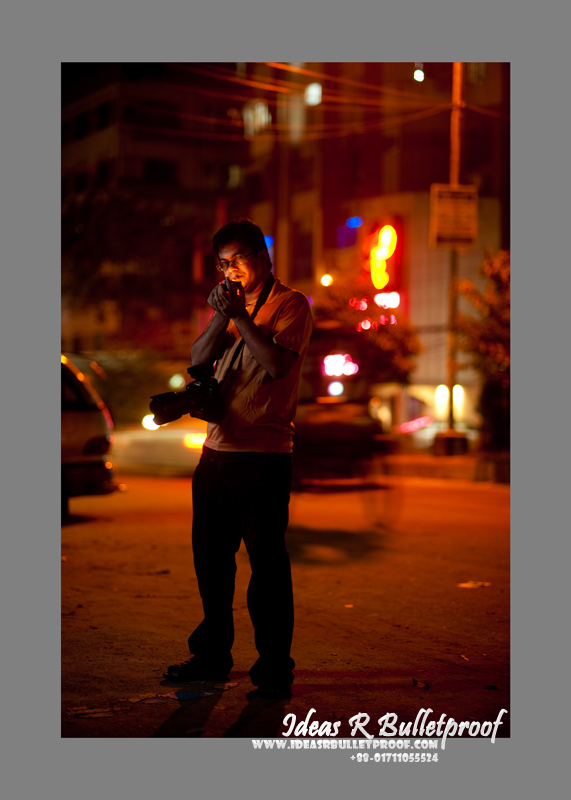
    night lights love 85mm.....

    I love my 85mm 1.8 lens... previously I had posted a blog on 85mm, utilising big windows.... but the best use of this lens doesn't come without some small lights in the background.... this lens produces some lovely bokeh.... I don't usually shoot @f1.8.... f2-2.8 produces really impressive bokeh, and at the same time, this improves sharpness.... the lens is quite sharp, mind you... but the sharpest results can be attained stopped down a little...


    talking of bokeh, not everything looks that well as a background.... if there is anything as book object, it has to be lights.... out-of-focus lights produce a dreamy backdrop, making it the perfect lens for night-time portraits.... half-body to full-body portraits produce the best results with this lens, when it really shows its colours...

    this lens loves street lights at night... lights and neon signs become dreamy and automatically improves the overall feel of the image.... wedding photographers love this lens.... I'm no wedding photographer, but I've used this lens at night many a times to know how good it is....

    at night, focusing is bit of an issue... but that natural with any lens at night.... some sort of focusing assistance has to be there.... and when we are talking of full-body portraits, the distance of the camera from the subject makes the camera's in-built focusing assistant much less effective.... this isn't a complain against this lens in any way.... its a trait of a lens that is 85mm in focal length.... you just have to know how an 85mm lens works...

    hope to post something similar on 50mm 1.4 and Sigma 150mm macro lenses sometime in future....

    Wednesday, 30 November 2011

    first looks at the parabola....

    30 November 2011
    Mohammadpur, Dhaka, Bangladesh

    this is more of a technical blog.... my strobist friends would be more interested in it than anyone else... just got my hands on my new Elinchrom Rotalux 100cm "Deep Octa".... so, I was just itching to put my hands on it.... I swooped on it like a bird of prey!!.... it didn't take long between unpacking and the first shoot.... although the setup was bit of a pain for me....

    tried to follow the instructions fully, but as it turned out, the instructions were for all Rotalux series products, which also included typical softboxes with four edges... but octa was definitely different.... and caused more pain than I had thought about.... the product's build quality is excellent, although the softbox material seemed a bit thin... but that thing also brought the weight down to something really manageable... the steel ribs are awesome... they really give confidence to the user that this softbox would bend, but not break; although this strength also makes it harder to setup in the first place... the strength of the ribs makes them twist and that deforms the shape of the softbox... but gets corrected once the softbox is fully setup for the first time....

    I had a hard time setting it up, really.... this was my first Elinchrom softbox, which may be one of the reasons behind finding it difficult to negotiate... but once the whole thing was setup, it looked brilliant!... I used the Deep Octa without the translucent dome that came with it, because apart from the dome, it already had a double diffusion... so, the light was already great.... the dis-assembly was another pain, as I struggled to find an easy way to get the tight ribs out of those sockets in the speedring.... it took me several minutes to figure out the best way.... and then it was easy as anything.... I timed both setup and dismantle at between 3:00 - 3:30 minutes.... and I wasn't rushing at all... the timing included unpacking from the nice soft bag that it came with....

    the practical weight (without the diffusion dome) of the softbox with the bag was just around 1.5kg, which is really within acceptable limits.... and considering the size of the soft bag (2ft 9inch) I thought it would be one of the most portable pieces in my collection.... the bag doesn't have any pockets for the diffusion panels, which would've been really nice though... but it gives great padded protection and gives a good feel....


    I only had a brief stint shooting with it and got some nice overall results.... the light modifier is a wonderful light controller... its a biggish light source, yet it doesn't spread the light everywhere.... it now gives me lots of new possibilities.... I tired it out with the Elinchrom Ranger RX Speed AS with A-head... I had my every ready model Lamisa ready in front of my camera.... and there you go... I was only looking for an excuse to shoot some frames.... she had her first haircut since her third birthday less than a week ago... so, the big "three" was still there to be photographed.... hope to write some more blogs on those soon enough.... glad that I had been able to break through the busy times and write a blog of some substance....

    anyway, lots more to come....

    Sunday, 3 July 2011

    battle of the boxes…..

    30 June 2011

    Mohammadpur, Dhaka

    just received the Westcott Apollo 28″ softbox…. had been waiting for it to complete the orders that I had placed for in recent times…. after some testing of the Shashinki 24″ and the Lastolite Ezybox 24″, I could get a sense of the difference among those two….. I’ve already posted a blog on the differences between the Shashinki and Ezybox…. that was mainly based on its utility and operations…. no attempt was made to compare the lights coming out of the two…. so, to fill this blank space, I decided to put all the three softboxes side by side and shoot some flashes through them...


    with a huge 28″ front, the Apollo is the obvious different one…. its the only one with the ability to receive any kind of flash…. the other two are predominantly hot-shoe flash softboxes…. the next difference lies in the way flashes are places in it…. the Apollo is manly designed as an indirect light source, with the flash shooting away from the subject; into a silver reflective surface…. that makes it possible for the Apollo to be bigger than the other two…. but I’ve noticed a significant amount of light-loss for the Apollo…. its a bigger light source alright, but it requires more power to properly illuminate the subject…. the Ezybox seemed to be the best light source with the most uniform output…. and it also looked the brightest…. its double diffusion proved to be very effective…. I thought there would be some light-loss because of that, but didn’t really see that…. it was in fact, the brightest of the three….

    the design of the Apollo makes it more suitable for studio….. it seems like a softbox that wants to sit back and relax, rather than hovering in the air on a hand-held boom…. it can be put on a boom, but I’m not really sure how it would perform that way…. a bit of wind may spoil the party….. and as this is an umbrella design, wind can certainly do damage to its structure….. and I’m not sure how it can be repaired if one of the steel rods inside is broken….. weight isn’t an issue, as it certainly is very light….

    the other unique feature of Apollo is that it holds the flash inside the softbox, which makes it almost mandatory to be triggered with a radio trigger…. and it certainly is a pain to remove the diffuser every time you need to change the power settings…. and its design makes it stand more upright, not encouraging bending forward or back, unlike the Shashinki, which has a ball-head, helping to move the softbox on its axis….. Ezybox, on the other hand, will stay straight, no matter what…..you will need a boom to give direction with it….

    the Apollo is an umbrella…. its purely an umbrella and works like an umbrella…. it folds like an umbrella…. a BIG umbrella…. while folded, its length comes down to around 3ft1inch…. thats a pain for sure!!…. the thing hardly has a weight, but takes up an odd amount of space…. and it also doesn’t come with any carrying pack, which makes it even more odd for carrying to locations….. I can take the Shashinki or Ezybox anywhere, but not the Apollo…. Shashinki comes with a small bag, in which the softbox can be folded and stored…. but the Ezybox comes with a big triangular bag, where every arm is two feet long…. it can be folded just like the Shashinki, but as it doesn’t come with a small bag, it requires some improvisation to carry it within a small space…. Ezybox is, of course, the lightest softbox…. its speed-ring and holder are made of plastic…. Shashinki’s are made of solid metal…. and the Apollo doesn’t even have a speed-ring…. the version that I ordered, didn’t come with a flash bracket… so, I’m using my umbrella adapter with it…. it would’ve been a pain had I not have this adapter….

    none of the softbox is a world winner…. they all have flaws and their own advantages… that makes them suitable for different purposes… knowing their boundaries is critical to utilising their full potential….

    for this test, I used a Nikkor 28-80mm lens on D700 with Elinchrom Skyport radio trigger to trigger the YN-560 inside the Apollo, which optically triggered a YN-560 inside the Shashinki and an SB-900 inside the Ezybox…. all were on Phottix lightstands…. all the flashes were fired at 1/32 power, and zoomed at 24mm…. the pics were shot at 1/160sec and ISO 100…. aperture ranged between f7.1 and f4.5….